


 Google Scholar
When uncertainty changes a maintenance decision.
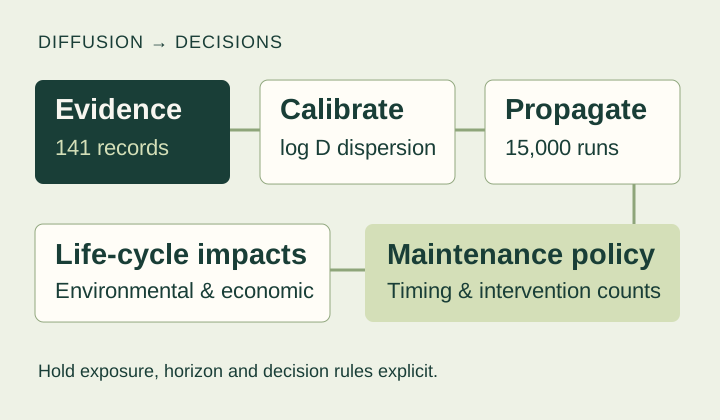
Carry diffusion-calibration dispersion into corrosion initiation, intervention timing, and life-cycle outcomes.
141 recordsOPC calibration evidence
Question, methods & contribution Civil engineering · McMaster University
P.Eng., M.E.Sc. PhD Candidate
Concrete durability.
Decisions with evidence.
I connect machine learning, service-life prediction, and life cycle assessment to support decisions for low-carbon concrete infrastructure. My current PhD focus is natural carbonation and climate-aware concrete selection.
Dual citizenship: Tunisia and Canada.
3 languages Fluent in Arabic, French and English.
Research collaborations & postdoctoral enquiries in concrete durability, service-life uncertainty, and sustainability.
Hamilton, Ontario, Canada

Education, research & support








Selected contributions
From traceable observations to structural condition and durability decisions. Explore the question, methods, evidence, and my contribution.
Carry diffusion-calibration dispersion into corrosion initiation, intervention timing, and life-cycle outcomes.
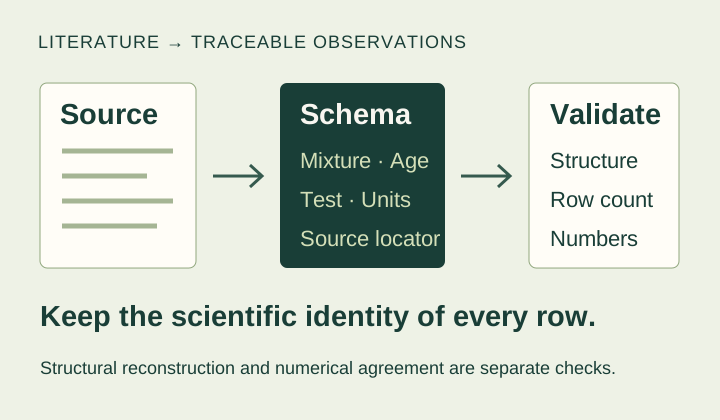
Reconstruct concrete durability observations while retaining mixture, age, test protocol, units, and source evidence.
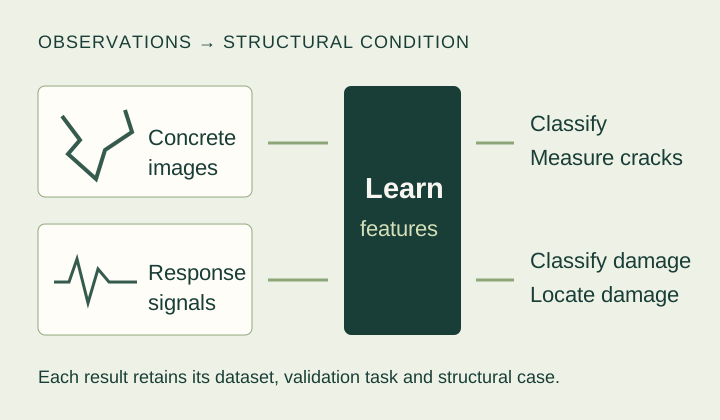
Connect crack classification and measurement with vibration-based damage localization.
Portfolio revised 24 October 2026. The aging-exponent article is accepted and available as a journal pre-proof. Remaining submission statuses retain their September 2026 snapshot.
Current PhD focus · McMaster University
My current PhD work investigates how natural carbonation influences the selection of lower-carbon concrete under present and evolving climatic conditions. I am developing a decision framework that connects published carbonation evidence with service-life screening, greenhouse gas emissions, and cost.
Would the concrete mixture selected for today’s exposure still satisfy the same carbonation requirement over a 50-year planning horizon under an evolving climate?
Ongoing PhD research. Model evaluation, evidence provenance, and recommendation reliability remain under investigation.
Explore the research question & methods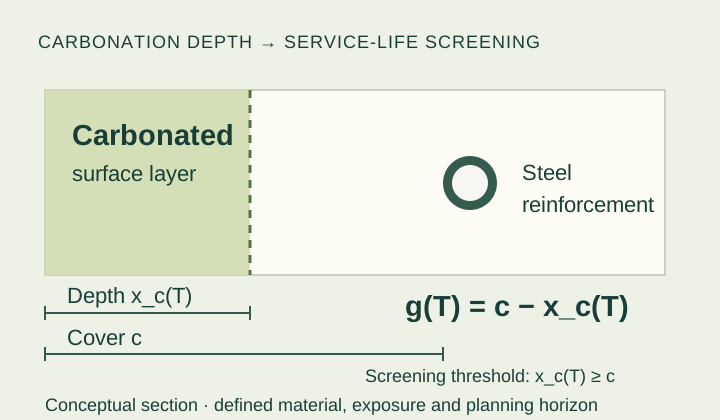
The question behind my work
My doctoral research examines how uncertainty in concrete deterioration changes service-life, maintenance, and environmental decisions.
I am a PhD candidate in Civil Engineering at McMaster University, supervised by Professor Moncef L. Nehdi. My programme links chloride transport evidence and probabilistic models with concrete performance comparisons. My current work extends that decision framework to natural carbonation under present and evolving climate scenarios.
My path connects civil engineering education in Gabès, structural engineering research at Western University, and professional practice in Ontario. That experience informs the questions I investigate and the decisions my models support.
01 / Research & projects
Research on the connection between material performance, uncertainty, and infrastructure decisions. Select a project to explore its question and methods.
Foundation interfaces at Laval, structural damage at Western, and durability informed sustainability at McMaster.
2018Mitacs internship · ENIG graduation project
How does the soil–pile interface model affect shaft capacity and settlement of non-displacement piles in sand under monotonic axial loading?
The Effect of Soil-Structure Interaction on the Monotonic Design of Geostructures
ENIG graduation report completed through the Laval internship. Defended on 20 September 2018. The report’s numerical comparison concerns monotonic axial response.
2020Master’s thesis · Structural engineering
Can convolutional neural networks identify damage classes and locations, and measure concrete cracks from images and acceleration signals?
Classification, Localization, and Quantification of Structural Damage in Concrete Structures using Convolutional Neural Networks
Western thesis repository, 2020; Chapters 2–4. The later 2022 BuildingNet article adds experimental QUGS validation.
2023–PresentPhD research · Civil engineering
How does uncertainty in chloride and carbonation evidence change service-life screening, maintenance assumptions, and environmental comparisons under defined exposure conditions?
Research theme: computational decision frameworks for low carbon concrete infrastructure
Doctoral research programme in progress. This entry states the research aims and scope; published study results are documented in the publication section.
Published research
Connecting deterioration to environmental assessment.
Journal manuscript under review
Reconstructing durability evidence from scientific literature.
Manuscript under review
Bringing uncertainty into the mixture search.
Accepted article & manuscript under review
Calibration windows, boundary conditions, and initiation.
Published research
Learning damage patterns from signals and images.
Research under development
Natural carbonation, service-life screening, and lower-carbon concrete selection.
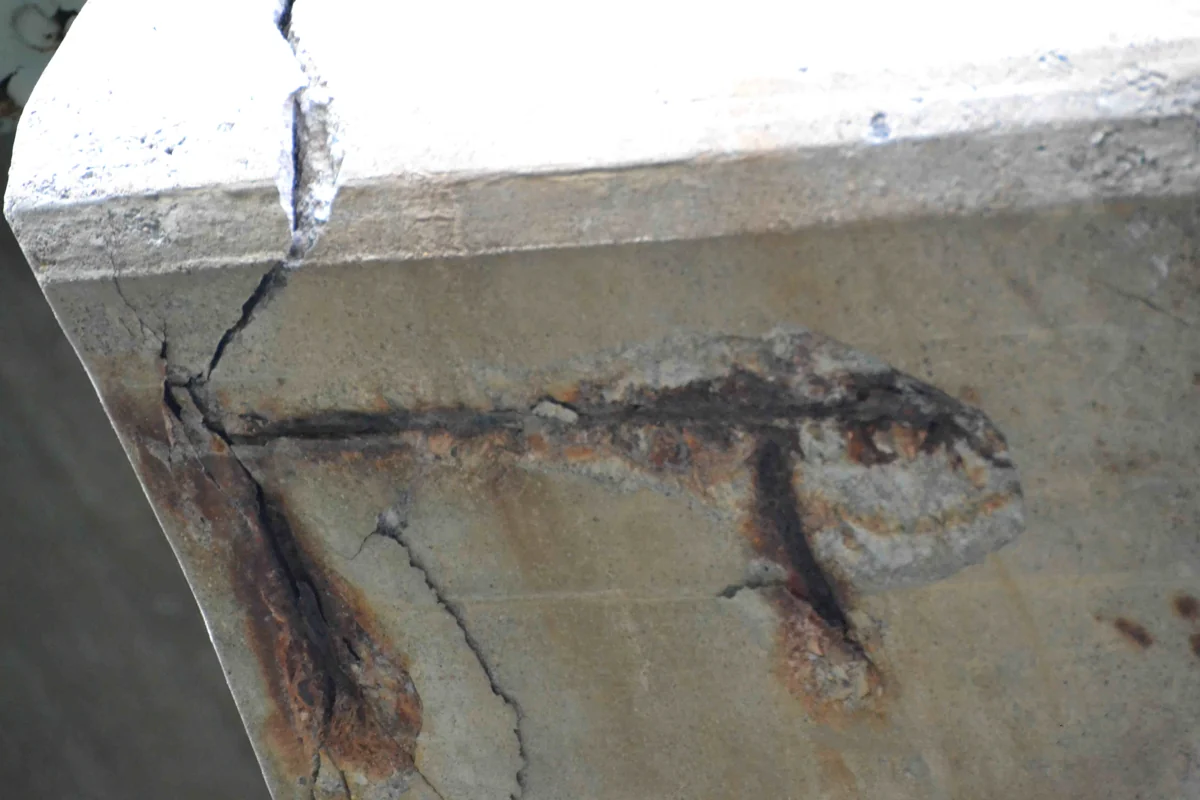
Deterioration & condition assessment
Cracking, spalling, and exposed reinforcement illustrate the conditions that motivate concrete monitoring and durability research.
QEW bridge · Achim Hering · 2012CC BY 3.0Resized for display.
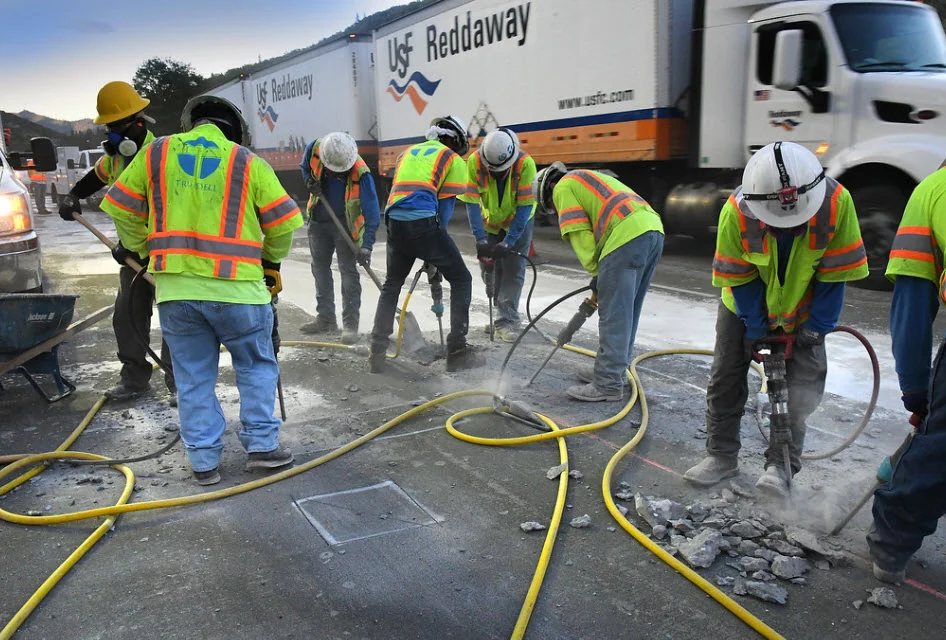
Maintenance & sustainable practice
Repair work uses materials and disrupts infrastructure service. My research brings maintenance assumptions into comparisons of concrete sustainability.
I-5 bridge repair · Oregon DOT · 2020CC BY 2.0Resized for display.
Lower material impactsConcrete mixture decisions
Longer service lifeDurability & maintenance
Evidence for interventionStructural condition monitoring
Illustrative bridge photographs provide context for the research themes.
Current focus: natural carbonation, climate-aware concrete selection, and durability-informed environmental comparisons.
02 / Publications
Eight articles on concrete durability, structural monitoring, and material prediction, including one accepted journal pre-proof, followed by three submitted manuscripts. Each article explains its research problem, evidence, methods, findings, and engineering implications.
Each study identifies its evidence sources. Authorship is recorded separately from any published contribution statement.
8 published journal articles
 2026
Cement and Concrete Composites · Article 106880 · Journal pre-proof
This study checks whether chloride aging exponents fitted to early measurements support the same 100-year transport projection as fits to the full available record for the same concrete mixture and test protocol.
Key finding Early- and full-window 100-year transport projections differ by at least a factor of two in 33 of 79 profile-diffusion trajectories (41.8%). The pooled rate across six protocol tiers is 134 of 312 (42.9%).
Service-life tools use a power-law aging exponent to describe how chloride transport changes with age. Earlier studies established dependence on binder, exposure, reference time, and test protocol, while practice often exports a fitted exponent beyond the measured age range.
The stability of a mixture-specific exponent across calibration windows requires a separate check from regression fit quality. Diffusion, migration, ponding, simulated-marine, and field measurements also represent different transport quantities.
Refit early and full measurement windows within each mixture and protocol, compare their independent 100-year transport projections, and quantify divergence by protocol tier, early-age sampling, and binder class.
The contribution is a same-mixture, paired-window audit of the power-law export workflow. It separates the profile-diffusion cohort used for service-life inputs from a pooled cross-protocol summary, and distinguishes direct 90-day evidence from two-youngest-age fallback fits.
Ordinary least squares fits the logarithm of the transport response against logarithmic exposure age for each early and full window. Independent intercepts and slopes generate a 100-year projection ratio R100. The audit flags ratios of at least 2 or at most 0.5, then reports protocol-specific and sampling-specific rates, publication-cluster uncertainty, and sensitivity to the window and threshold.
Pairing fits within one source, mixture, and protocol limits source and mixture confounding. Independent fits retain changes in both intercept and slope. OLS supplies a common estimator where replicate-level variance is unavailable; the full-window fit supplies an available-data comparator.
High divergence affects 41.8% of profile-diffusion trajectories and 42.9% of the pooled corpus. The rate is 37.1% for 224 trajectories with direct early-window evidence and 58.0% for 88 fallback trajectories. Median full-window R² is 0.96, showing that fit quality and extrapolation stability measure different properties. Rates describe the audited evidence and the stated twofold, 100-year screen.
Before exporting an aging exponent into a service-life model, report its protocol, exposure-age basis, calibration windows, and projection sensitivity. The divergence ratio compares transport projections; converting it into an initiation-time multiplier requires a separate chloride-ingress calculation with defined cover, boundary conditions, and chloride threshold.
Accepted 18 October 2026. Journal pre-proof verified 24 October 2026. Summary follows the pre-proof abstract and Sections 2–6; final typesetting and bibliographic volume assignment remain pending.
2026Cement and Concrete Composites · 169, 106552
This study follows uncertainty in calibrated chloride diffusion from corrosion initiation to repair timing, maintenance emissions, and life cycle cost.
Key finding In the reference scenarios, accounting for diffusion uncertainty increases expected maintenance demand by approximately 20–40% relative to deterministic estimates.
Fickian chloride models support service life calculations, and probabilistic approaches already account for uncertain exposure or corrosion thresholds. Machine learning studies estimate diffusion coefficients from heterogeneous experimental evidence.
The dispersion produced by diffusion calibration is commonly reduced to a point prediction. Its effect on threshold triggered maintenance decisions and their environmental and economic consequences requires explicit propagation.
Quantify calibration residual dispersion, propagate it into corrosion initiation distributions, and compare resulting intervention demand, greenhouse gas emissions, and discounted costs with a deterministic baseline.
The contribution is a calibration to decision chain that carries empirically estimated diffusion dispersion into finite horizon maintenance rules. It identifies when threshold crossings amplify parameter uncertainty into different intervention decisions.
Gradient boosting calibrates log10 Dapp. CTGAN augmentation is restricted to training. Residual dispersion is measured on 36 real test observations after duplicate pruning. A lognormal diffusion distribution and a chloride threshold distribution feed 15,000 Fickian simulations per case, followed by sealer and overlay policy scenarios, emissions accounting, and discounted costs.
Log space represents multiplicative diffusion scatter while retaining positive coefficients. Real test residuals provide the dispersion parameter. Keeping the transport model and decision rules explicit isolates how the same uncertainty changes engineering decisions.
The residual standard deviation is σlog = 0.162. The paper reports approximately 20–40% higher expected maintenance demand than deterministic estimates, with environmental and economic impacts reaching 1.5–2 times deterministic estimates within the reported 5th–95th percentile ranges. These results belong to the specified exposure and maintenance scenarios.
The framework supports inspection and maintenance planning through initiation percentiles, repair likelihood, intervention counts, and impact distributions. Application to a particular asset requires its exposure boundary conditions and repair policy; the analysis concerns corrosion initiation and stylized maintenance renewal.
Version of record: Sections 3–7. Results describe the paper’s reference exposure and policy scenarios.
 2026
Renewable and Sustainable Energy Reviews · 231, 116730
This review establishes how durability evidence, machine learning, service life models, and LCA can describe the same time dependent concrete performance.
Key finding The synthesis identifies environmental ranking reversals when service life or transport performance replaces concrete volume as the comparison basis.
Durability testing describes transport and deterioration, machine learning predicts material indicators, and LCA evaluates environmental burdens. Existing studies connect these domains using different performance measures and lifetime assumptions.
A predicted material indicator, an assumed design life, and an impact per cubic metre can represent different functions. Their coupling can therefore rank mixtures under incompatible exposure, deterioration, and maintenance assumptions.
Assess how chloride and carbonation evidence can enter service life models, examine the admissibility of machine learning outputs, evaluate functional units and maintenance assumptions in LCA, and define a shared comparison framework.
The deterioration informed sustainability framework uses a deterioration trajectory as the common representation across testing, prediction, service life, and environmental assessment. Its contribution is a set of compatibility rules for coupling these domains.
PRISMA screening was followed by structured extraction of mechanisms, test protocols, exposure, transport parameters, prediction targets and validation, service life formulations, functional units, boundaries, and maintenance scenarios. The synthesis evaluates compatibility between successive parts of the durability to LCA chain.
A cross domain synthesis can assess whether an output represents the state, exposure, and time evolution required by the next model. The shared deterioration representation supplies the conditions needed for interpretable environmental comparisons.
The review reports transport variation of one to two orders of magnitude across binder and test conditions. It identifies cases in which environmental rankings reverse when service life or transport informed functional units replace volumetric metrics. These are literature synthesis findings, with the framework defining how comparisons should be constructed.
The framework helps engineers compare binders under a common exposure, deterioration endpoint, functional unit, and maintenance scenario. It guides evidence selection for durability design and LCA; a mixture specific numerical ranking requires compatible inputs for the chosen application.
Version of record: Sections 2–6. The 184 screened studies and 14 contextual works are separate evidence sets.
 2022
Automation in Construction · 139, 104271
BuildingNet learns damage signatures directly from acceleration signals to detect damage and identify its location using a single measurement channel.
Key finding The published study reports damage detection and localization with both clean and noisy signals. Accuracy depends on the structural case, sensor configuration, and damage class.
Vibration monitoring uses structural response measurements to identify changes in condition. Conventional workflows often extract modal or statistical features before applying a damage classifier.
Feature extraction and multiple sensor requirements can complicate monitoring. The study examines whether a network can learn damage information from raw acceleration while reducing the required measurement channels.
Develop BuildingNet, assess damage detection and localization, compare single and multiple channel inputs, and investigate network depth, training data size, and signal noise.
A one dimensional convolutional network performs feature learning directly on time domain acceleration. The contribution links this representation to classification and localization under a single channel measurement configuration.
BuildingNet applies one dimensional convolutional feature extraction and classification to acceleration windows. Parametric studies vary network layers, training set size, channel count, and added noise. Numerical and experimental cases test damage detection and location prediction.
Temporal convolutions learn local signal patterns directly from acceleration. Comparing channel counts and noise conditions tests the feasibility of reducing instrumentation while retaining damage information.
The article reports successful localization in numerical mid rise structural cases and experimental QUGS validation. Gaussian noise levels up to 20% are investigated. The published record does not provide a verified single accuracy figure for this summary; thesis experiment scores are not presented as final article scores.
The work motivates monitoring with fewer measurement channels. Deployment requires validation for the asset’s geometry, sensor position, excitation, environmental variation, and plausible damage states. Single channel feasibility in the studied cases does not establish coverage of every damage scenario.
Published abstract and publisher excerpts; numerical acquisition details from the author’s 2020 thesis, Chapter 4. The thesis precedes the final QUGS validation.
 2021
Archives of Computational Methods in Engineering · 28, 2621–2643
This review connects machine learning choices with the signals, images, and damage detection tasks used in civil structural health monitoring.
Key finding The synthesis shows why algorithm choice must follow the monitoring task, input quality, and available data. Its recommendations are specific to the reviewed applications.
Civil structures were already monitored through sensor responses and visual records. Machine learning applications spanned bridges, buildings, dams, tunnels, and wind turbines.
The expanding literature used different inputs, algorithms, and damage targets. Engineers needed a structured account of their suitability and practical limitations.
Survey civil monitoring applications, compare algorithm strengths and weaknesses, and identify implementation requirements and research needs.
The review organizes image and vibration approaches around their inputs, learning tasks, and engineering outputs, making application differences explicit.
The synthesis compares clustering, regression, and classification applications across the two monitoring streams. Application tables and critical discussion connect algorithms to input preparation and damage assessment.
Grouping studies by measurement type and task makes their operating requirements easier to compare. It supports selecting candidate methods for a defined monitoring problem.
The companion thesis discussion identifies CNN feature learning and transfer learning opportunities, data and computing demands, SVM kernel and scaling choices, and sensitivity to image quality. Research needs include linking visible damage to physical mechanisms and extending real time and unsupervised monitoring.
The review provides a starting point for choosing monitoring methods for aging infrastructure. Asset specific validation remains necessary because data quality, structure type, and damage definitions vary across applications.
Published abstract; detailed application synthesis from the author’s 2020 thesis, Chapter 2. Exact screening details await verification against the final article.
 2021
Construction and Building Materials · 310, 125279
This review examines how computational intelligence estimates compressive strength in modern concrete mixtures and how data and model settings affect reported performance.
Key finding The 65 paper synthesis connects performance to mixture type, dataset characteristics, and model settings. Reported scores retain the validation conditions of each source study.
Empirical strength models supported conventional mixture design. Modern composites introduced more complex relationships between constituents and compressive strength.
Prediction accuracy depends on the dataset and hyperparameters. Results from different modern mixtures therefore require careful interpretation before a model is selected.
Critically compare computational intelligence approaches for modern concrete strength and explain their parameters, performance, advantages, and limitations.
The review brings material specific applications together with model settings and reported accuracy, supporting a more informed comparison of candidate predictors.
The authors compare published algorithms, datasets, material systems, model parameters, hyperparameters, and reported accuracy. Each result is interpreted within its original study.
Strength is a continuous prediction target. Reviewing settings alongside material and data characteristics helps explain variation in regression performance.
The synthesis identifies the importance of data structure and model configuration. It supplies comparative guidance rather than a new common dataset benchmark or a pooled prediction error.
The findings help engineers identify model families worth validating for a specified modern mixture. Such validation can support strength estimation and mixture development under the project’s material and testing conditions.
Published abstract and publisher introduction and section excerpts. Detailed search dates and screening procedures remain to be verified from the full article.
2020Cement and Concrete Composites · 114, 103781
This study combines crack detection and orientation classification with image processing to measure crack length, width, and direction in concrete.
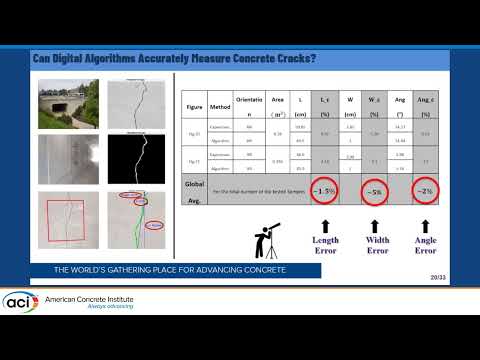
Key finding The published abstract reports 96.17% combined classifier test accuracy and mean relative measurement errors of 1.5% for length, 5% for width, and 2% for orientation.
Manual crack inspection requires time and can vary between inspectors. Earlier image methods detected cracks or classified orientations, while measurement depended on image processing and calibration.
A useful inspection workflow needs both a damage label and geometric measurements. Classification accuracy alone does not establish the accuracy of crack dimensions.
Train crack and orientation classifiers, combine their tasks, extract crack geometry, and compare image based measurements with field observations.
The workflow connects deep learning classification to geometric crack quantification. It evaluates the recognition and measurement tasks separately.
Convolution, ReLU, pooling, dropout, and softmax layers classify crack presence and orientation. Image enhancement, an improved Otsu threshold, morphology, and geometric processing estimate length, maximum width, and direction. A physical scale converts pixels to dimensions.
CNNs learn visual features for classification. The geometric stage produces the dimensions needed for inspection, and its separate field comparison tests measurement performance.
The combined classifier achieved 97.63% training, 96.5% validation, and 96.17% test accuracy. Reported mean relative errors were 1.5% for length, 5% for width, and 2% for orientation; the companion field verification used ten images. Intersecting cracks and scale calibration limit transfer to new images.
The workflow supports concrete condition surveys by attaching dimensions and orientation to detected cracks. These observations can inform inspection priorities and engineering assessment; interpretation still depends on the member, loading, exposure, and calibrated image scale.
Published abstract; dataset preparation, splits, and field verification documented in the author’s 2020 thesis, Chapter 3. The source image collection and the selected training cohorts are distinct.
2020Construction and Building Materials · 260, 119889
This review examines machine learning for concrete strength and stiffness, relating model choice to nonlinear material behaviour and the available data.
Key finding Reviewed comparisons report benefits over empirical equations under their source study conditions. Model selection depends on nonlinearity, input count, and dataset size.
Empirical equations related concrete properties to composition and curing. Complex mixtures increased the challenge of representing these multivariable relationships.
Engineers needed guidance on flexible predictors and on the conditions supporting their reported performance.
Critically assess machine learning approaches for compressive, tensile, and shear strength and elastic modulus, and identify practical selection considerations.
The review links algorithm families and reported applications with recommendations based on the relationship being modelled and the data available.
The critical synthesis compares neural networks, support vector machines, decision trees, and evolutionary approaches, including statistical performance measures and published comparisons with empirical equations.
The stated selection focuses on common methods with enough detail for assessment. Comparing them by property and data conditions supports practical model selection.
The review describes a non exhaustive set of comparisons using the same test data that favour machine learning over empirical equations. Recommendations relate method choice to nonlinearity, input count, and sample availability. A pooled accuracy estimate is not established.
The synthesis helps engineers evaluate candidate predictors for design inputs and mixture development. Reliable use requires testing under the intended material domain, property definition, and validation conditions.
Published abstract and publisher introduction, discussion, and recommendation excerpts. Corpus totals, search details, and numerical table entries await full text confirmation.
Try another title, journal, author, or topic.
Manuscripts in peer review
Submission statuses recorded on 25 September 2026
Research on extracting durability evidence, optimizing low-carbon concrete, and improving chloride-based service-life assessment.
3 submitted manuscripts
2026Submitted to Automation in Construction
Develops a schema-constrained workflow to reconstruct concrete durability data from scientific literature with explicit extraction and validation controls.
Under review · Submitted 29 April 2026
 2026
Submitted to Journal of Cleaner Production
Examines how chloride-transport uncertainty changes the search for concrete mixtures that balance low carbon impact with durability.
Under review · Submitted 24 August 2026
 2026
Submitted to Advanced Engineering Informatics
Evaluates the role of probabilistic surface-chloride boundary conditions in screening corrosion initiation for marine concrete.
Under review · Submitted 31 August 2026
No submitted manuscripts match this search.
Journal covers identify the publication venues and are representative publisher images.
03 / Recognition
Fellowships, scholarships, and awards supporting my academic work and recognizing contributions to engineering education.
Teaching recognition & an award-winning research contribution
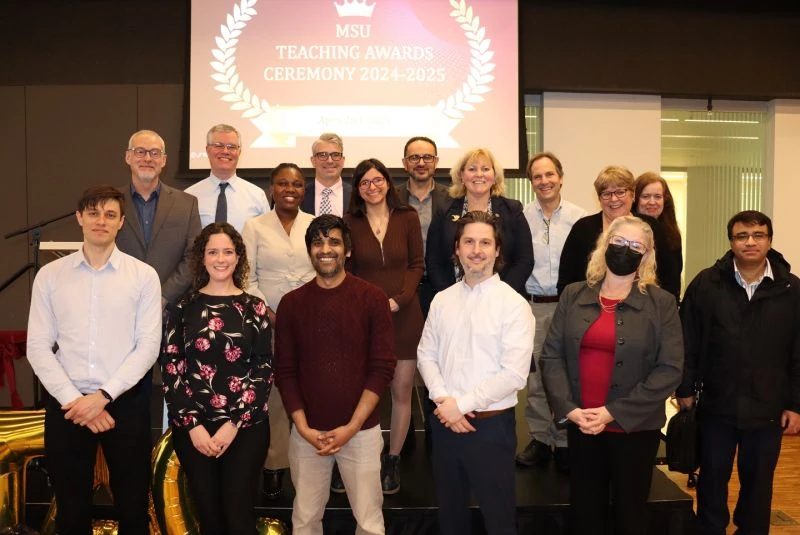
McMaster Students Union Teaching Assistant Merit Award. Pictured with engineering award recipients at the 2025 teaching awards ceremony.
Photo: MSU / McMaster Engineering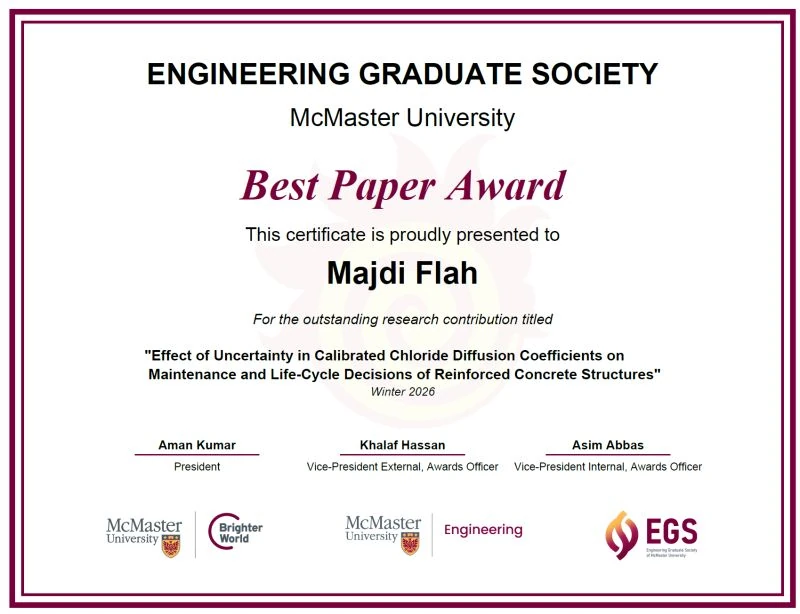
Engineering Graduate Society recognition for research on chloride diffusion uncertainty, maintenance, and life-cycle decisions.
Certificate: Majdi Flah / McMaster EGSSix awards supporting doctoral, graduate, and international research
McMaster University · Ontario Graduate Scholarship programme
Scholarship supporting my doctoral research at McMaster University for the 2026–2027 academic year.

Transportation Association of Canada Foundation
Doctoral scholarship funded by The Esch Foundation and awarded through the TAC Foundation.

American Concrete Institute Foundation
Fellowship supporting my graduate work on concrete durability and infrastructure sustainability.

Engineers Canada
Graduate scholarship supporting my engineering research at McMaster University.
Mitacs
Graduate scholarship supporting my research at Western University.
Mitacs
Scholarship associated with my Globalink research internship at Université Laval.
04 / Professional experience
Structural design, site inspections, and technical coordination across three engineering roles in Ontario.
Hamilton, Canada
Structural Engineer
Precast concrete design for transportation and building infrastructure.
Waterloo, Canada
Structural Engineer
Structural design, site inspections, and drawing review for residential and industrial projects.
Ayr, Canada
Technical Services Project Coordinator
Technical coordination among contractors, consultants, and municipalities.
Research at Université Laval & field coordination at OMV
Québec, Canada
Research internship · Mitacs
Université Laval
An international research internship that supported my ENIG graduation project on pile–soil interaction.
May–August 20164 months

Gabès, TunisiaOn-site
Field internship · Oil and gas
OMV
An on-site internship supporting technical drawing review, field investigations, construction safety, and quality assurance in oil and gas engineering.
05 / Teaching
Teaching assistantships at McMaster and Western, and professional course instruction through EPIC Education.
Current courseMcMaster University
Graduate Teaching Assistant · PhD teaching assistantships
2026CIV ENG 2E03
Leading laboratory sessions that connect numerical methods and computational tools with civil engineering problems.
Laboratory sessions
Laboratory teaching and guidance on understanding and applying computational methods.
Teaching recordMcMaster University
Graduate Teaching Assistant · PhD teaching assistantships
Winter 2026CIV ENG 2C04
Supporting undergraduate learning in stress, strain, member response, and structural mechanics calculations.
Tutorials and student support
Tutorial instruction and technical guidance in solving structural mechanics problems.
Teaching recordMcMaster University
Graduate Teaching Assistant · PhD teaching assistantships
Fall 2024CIV ENG 4N04
Teaching support in load paths, steel member behaviour, connections, and structural design calculations.
Design tutorials and student support
Delivered tutorials and technical guidance. McMaster teaching recognition followed in 2025.
PlannedMcMaster University
Planned teaching · Civil engineering
Upcoming term
Planned contribution to Concrete Design teaching at McMaster University.
Teaching recordWestern University
Graduate Teaching Assistant · Master’s teaching assistantships
2019–2020
Led workshops and provided technical support during the master’s programme in structural engineering.
Applied workshops
Applied workshop teaching and guidance on course problems. Received Western’s Teaching Assistant Excellence Award in 2020.
Teaching recordWestern University
Graduate Teaching Assistant · Master’s teaching assistantships
2019–2020
Led applied steel design workshops for students during the master’s programme.
Applied design workshops
Workshop instruction and technical support documented in the teaching experience record.
 Teaching record
EPIC Education
Course Instructor · Professional development instruction
Professional development
Professional instruction on temporary works, material selection, structural design, and formwork economy.
Professional training
Taught this EPIC course. The linked catalogue provides its subject coverage.
Teaching recordEPIC Education
Course Instructor · Professional development instruction
Professional development
Training in machine learning workflows, model evaluation, and applications to civil engineering problems.
Professional training
Delivered professional instruction using engineering case studies and machine learning workflows.
Teaching recordEPIC Education
Course Instructor · Professional development instruction
Professional development
Instruction in civil engineering principles for professionals working across disciplines and infrastructure projects.
Professional training
Taught this EPIC course for an audience working outside civil engineering specializations.
06 / Education, training & service
Academic distinctions and a research scholarship shaped the path from Tunisia to graduate study in Canada.
Ranked first at Boulbaba High School in the mathematics baccalaureate.
Gabès, TunisiaGraduated second in the civil engineering cohort at ENIG.
National Engineering School of GabèsSelected for a Mitacs scholarship and research internship at Université Laval.
Québec, CanadaDoctoral research in Civil Engineering at McMaster University.
Hamilton, CanadaDoctoral research on durability-informed computational decisions for low-carbon concrete. Supervisor: Professor Moncef L. Nehdi.
Graduate research on structural damage detection using vibration-response data, structural dynamics, and machine learning. Successfully defended the master’s thesis in 2020.
ENIG graduation research on pile–soil interfaces, shaft capacity, and monotonic axial response. Compared Abaqus models with published experimental benchmarks.
Graduated second in a cohort of 90 civil engineering students at the National Engineering School of Gabès. Co-founder of the civil engineering club and active in Junior Enterprise ENIG.
Selected engineering courses listed on my LinkedIn profile.
Preparatory studies completed with a ranking of 460 out of 5,000, followed by civil engineering studies at ENIG.
Programme focus for the national engineering entrance examination.
Graduate student representation and contributions to discussions on academic issues and community communication.
Representation of Civil Engineering graduate students in steward council and general membership meetings.
Review of research on concrete materials and machine-learning prediction.
Doctoral course on corrosion mechanisms, electrochemistry, reactive transport, phase equilibria, and thermodynamic modelling.
CIV1260 · 27-contact-hour graduate course and industry workshop coordinated by Professor R. Doug Hooton, covering cement chemistry, hydration, SCMs, microstructure, and deterioration mechanisms.
Toronto, Canada
Research presentation on concrete surface assessment using deep learning.
Canadian Society for Civil Engineering
Virtual conference
Research presentation on computer-vision techniques for aging reinforced concrete infrastructure.
Prototypes for Humanity
Dubai, United Arab Emirates
Short paper accepted for the 2026 programme. Status: accepted.
Graduate study & conference presentations

After successfully defending my Master of Engineering Science thesis on structural damage detection at Western University.
Photo: Majdi Flah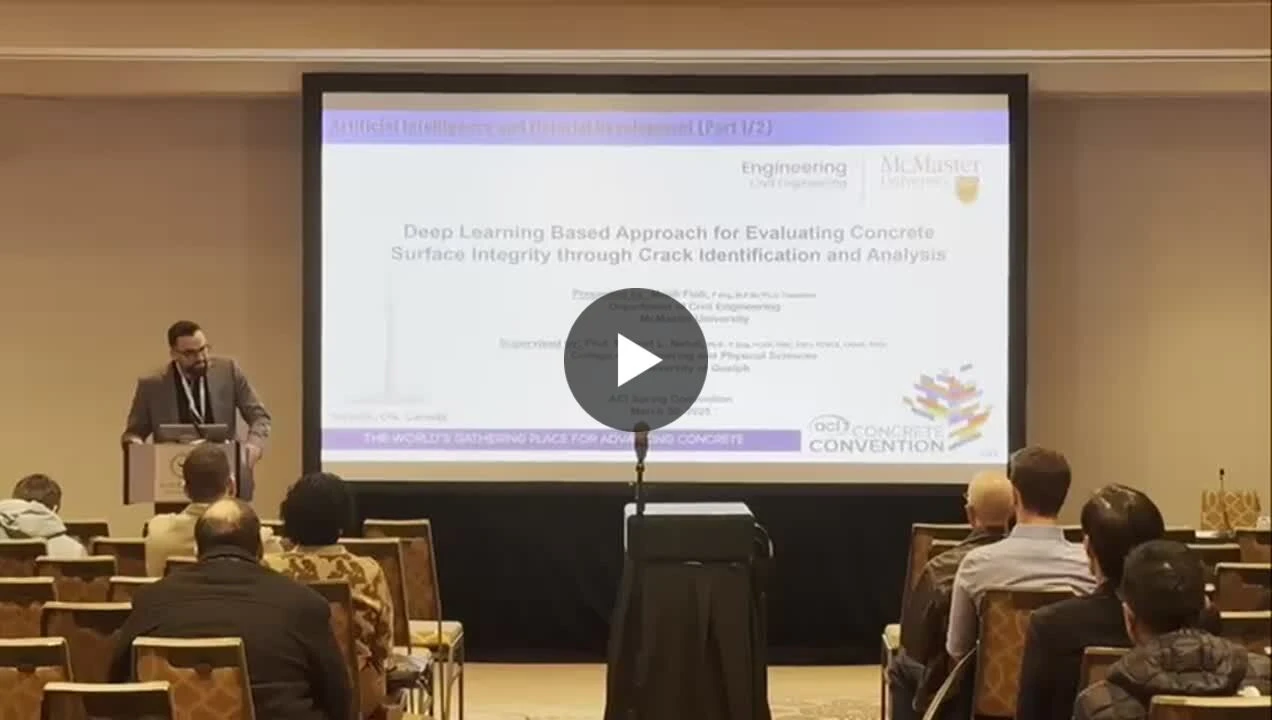
Presenting research on deep learning for concrete surface assessment at the ACI Spring Convention.
Presentation video: Majdi Flah00 / Vision & purpose
My direction connects engineering research, professional practice, education, and service to the community.
Vision La vision
I want to help build a future where concrete infrastructure serves communities for longer and material choices account for deterioration, maintenance, and environmental impact throughout service life.
Objectives Les objectifs
Channels Le canal
I communicate through journal articles, conferences, university teaching, professional courses, LinkedIn, and YouTube. Each channel connects the research with the people who can use it.
Purpose & value Le sens
Safer infrastructure, responsible use of resources, and accessible education give this work its purpose. My commitment to student organizations, environmental action, and knowledge sharing grows from that same aim.
Explore my community work07 / Community & social impact
Alongside engineering, I have helped start student organizations and an environmental NGO, and contributed to student representation and outreach.
 01
Club Génie Civil ENIG
Student community
Co-founded the civil engineering club at the National Engineering School of Gabès.
 02
ENIG Junior Entreprise
Entrepreneurship & leadership
Served as Vice President of Events and as a member of Junior Enterprise ENIG.
 03
An IIDEBATE initiative
Environment & civic engagement
Co-founded Arborization, an environmental NGO launched through an IIDEBATE initiative.
Today, I continue that commitment through the McMaster Engineering Graduate Society, CUPE Local 3906, teaching, and sharing research opportunities with students.
08 / LinkedIn posts
Selected posts on engineering research, doctoral milestones, and exchanging ideas with the concrete community.
My Winter 2026 EGS Best Paper Award post explains how chloride diffusion uncertainty connects predictive modelling with service life, maintenance, and life-cycle decisions.
Read my post on LinkedInOntario Graduate Scholarship
CAD 15,0002026–2027My Ontario Graduate Scholarship announcement reflects on the revisions, uncertainty, and persistence behind doctoral research.
Read my post on LinkedInA reflection on presenting concrete surface assessment research at the ACI Spring Convention in Toronto, exchanging ideas, and learning from academic and industry mentors.
Read my post on LinkedIn09 / YouTube & knowledge sharing
Watch my ACI presentation on concrete surface integrity, alongside videos on concrete research and international research opportunities. The presentation recording is hosted by the American Concrete Institute.
 18:36
My presentation on combining deep learning and image processing to identify concrete cracks and quantify their length, width, and orientation.
 4:30
The connection between concrete durability, service life, and environmental decisions.
 6:34
An introduction to my doctoral research and its infrastructure applications.
 2:07:07
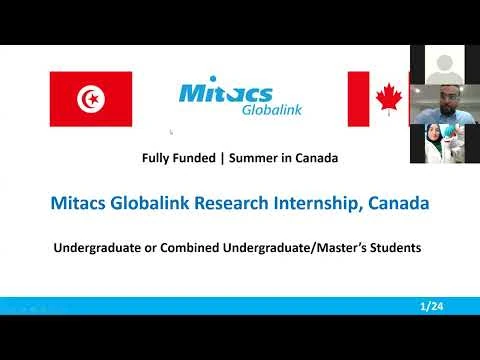
Sharing guidance on international research opportunities through Mitacs.
Concrete research · Engineering education · International opportunities
Explore my channel10 / Contact
For research collaborations and postdoctoral enquiries in concrete durability, probabilistic modelling, and infrastructure sustainability.
Department of Civil Engineering
McMaster University
Hamilton, Ontario, Canada