Current PhD research · ongoing
Climate-aware carbonation decisions
Natural carbonation, service-life screening, and lower-carbon concrete selection.
Portfolio revision: 17 October 2026
Research question
Would the concrete mixture selected for today’s exposure still satisfy the same carbonation requirement over a 50-year planning horizon under an evolving climate?
Material domain
The focus is low-clinker concrete incorporating supplementary cementitious materials, including fly ash and slag, within the material and exposure ranges supported by the evidence.
Evidence & provenance
Published natural-carbonation observations are examined alongside mixture composition, curing, exposure conditions, and measurement age. Study and mixture identifiers support provenance checks, overlap screening, and independent evaluation.
Methodology & evaluation
The work combines data auditing, statistical and machine-learning analysis, and uncertainty-aware service-life screening. Evaluation considers held-out studies or locations and distinguishes interpolation within an evidence domain from transfer to new material or exposure conditions.
Engineering comparison
Present-climate and evolving-climate scenarios are compared over a 50-year planning horizon while keeping cover depth, strength requirements, and exposure assumptions explicit. The intended outputs are candidate-mixture comparisons, probabilities of reaching a stated carbonation limit, and their GWP and cost consequences.
Interpretation of the limit state
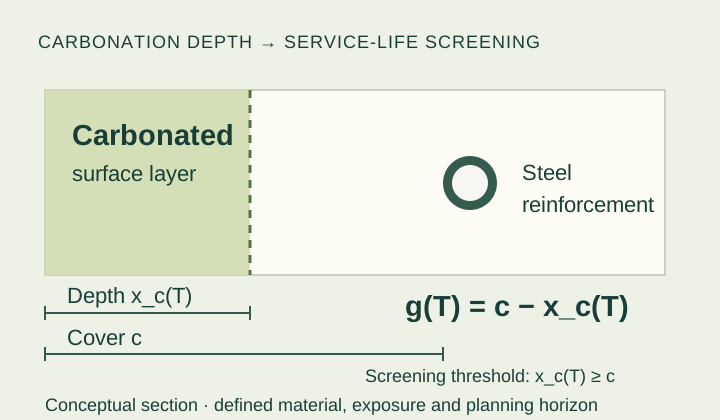
Carbonation depth is compared with reinforcement cover as a screening limit state. Corrosion rate and propagation require separate measurements and validation.
Why this matters
The aim is to identify when a lower initial production impact remains an environmental advantage after the durability requirements and planning horizon are accounted for.
Research status
Ongoing PhD research. Model evaluation, evidence provenance, and recommendation reliability remain under investigation.